
If you want to start a tablet supplement brand, the first decision is not the logo or the bottle. It is whether your formula actually wants to be a tablet. Tablets are compact, inexpensive per unit at volume, and easy to count into a bottle. They also ask more of the powder than any other format we make. This guide walks through the decisions we see founders make, in roughly the order they should make them.
When a tablet is the right first SKU
A tablet makes sense when the dose fits in a size people will accept, the ingredients can be compressed, and you expect to sell enough units to justify a real production run. Hard-pressed tablet runs start at 30,000 tablets, which is 1,000 bottles of 30 or 500 bottles of 60. Sublingual tablets start at 60,000. Tablet pressing loses some powder on every run, so those minimums are the smallest runs that work.
If you are still testing whether anyone will buy the product, a lower-minimum format may be the better first step. If you already know your volume, or a retailer is asking for a compact, shelf-stable unit, a tablet is often the most efficient answer. Our capsule and tablet manufacturing page compares the two formats side by side.
Choose the tablet type before the formula is final
The tablet type changes the excipients, the tooling and the packaging, so pick it early.
- Uncoated compressed tablets. The simplest build. Good for minerals and many botanicals, as long as the taste and appearance are acceptable.
- Film-coated tablets. A thin coating helps with taste, odor, swallowing and appearance. It adds a process step and should be planned into the quote from the start.
- Sublingual tablets. Small tablets made to dissolve under the tongue. The formula has to be built around taste and fast dissolving, which limits the dose and the ingredient list. See our sublingual tablet manufacturing page for details.
- Effervescent tablets. Larger tablets that fizz and dissolve in water. The acid and carbonate system that makes them fizz also reacts with humidity, so they are packed in moisture-proof tubes or foil. Our effervescent tablet manufacturing page covers formats and counts.
Powder flow and compression basics
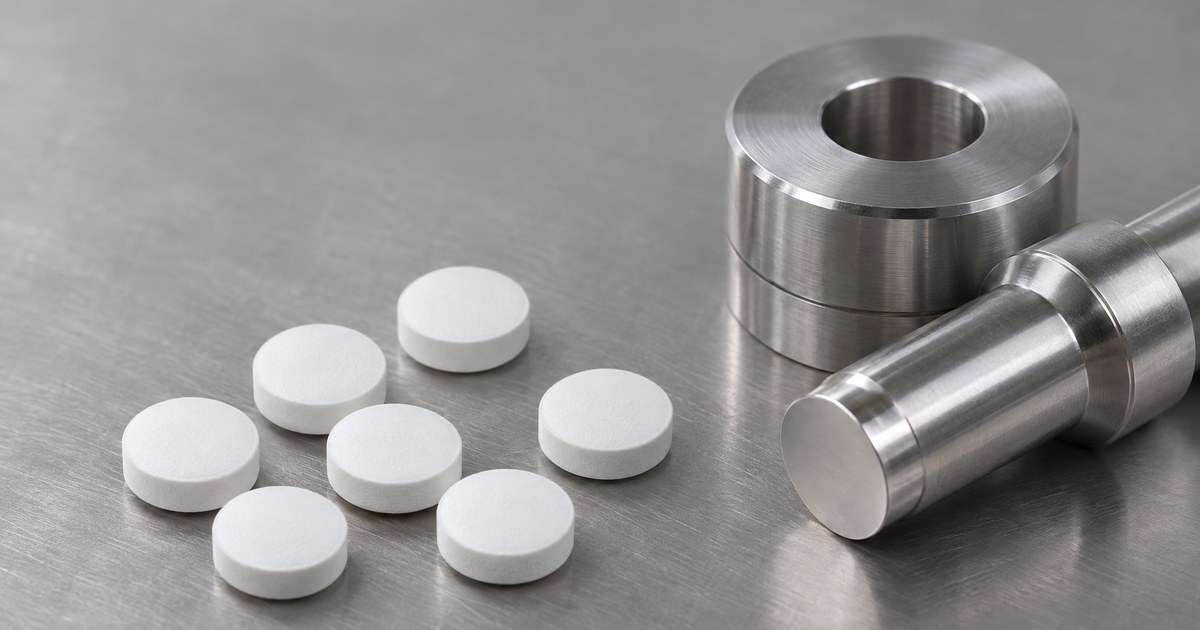
A tablet press fills a die with powder by volume, then compresses it between two punches at high speed. Every tablet weighs what it weighs because the powder flowed into the die the same way every time. If the blend flows poorly, tablet weight drifts, and so does the amount of each ingredient per tablet.
Formulators characterize flow with tests such as angle of repose, bulk and tapped density, Carr’s compressibility index and the Hausner ratio. An FDA research group that compared these methods found the compendial tests were often not sensitive enough to detect minor variations in flow, and that powder rheometer measurements such as cohesivity and caking strength added useful detail (Shah, Tawakkul and Khan, 2008). The practical point for a founder: a sticky botanical extract or a fluffy, low-density powder may need granulation or extra excipients before it will run.
Three compression defects come up most often:
- Capping is when the top of the tablet separates like a cap after ejection. In one compaction simulation study, capping correlated with high elastic recovery in the die, a high Poisson’s ratio, low tensile strength and radial die-wall pressure (Paul and Sun, 2017).
- Lamination is when the tablet splits into layers through the band. Mazel and Tchoreloff describe three types: air entrapment, shear stress as the tablet leaves the die, and tensile stress in convex tablets. Slowing the press or adding precompression helped the first type, and a tapered die stopped the second (Mazel and Tchoreloff, 2022).
- Sticking is when powder adheres to the punch faces, which pits the tablet surface and can change tablet weight. It is managed through formulation, lubrication and tooling choices.
None of this is something you need to solve yourself. It is why the first thing we do with a tablet brief is look at the actual ingredients, not just the label.
Label and count planning
The Supplement Facts panel is governed by 21 CFR 101.36. For a tablet, it lists the serving size (for example, 2 tablets), the amount of each dietary ingredient per serving, and the percent Daily Value where one has been established. FDA’s Dietary Supplement Labeling Guide covers the other required elements, such as the statement of identity, net quantity of contents and other ingredients.
Your serving size and bottle count drive everything else. A 2-tablet serving in a 60-count bottle is a 30-serving bottle, and a 30,000-tablet run becomes 500 bottles. Settle serving size, tablet count per bottle and bottle size before artwork, because a change in any one of them changes the label, the run math and sometimes the tooling.
Tablets made in a GMP environment are produced under the dietary supplement manufacturing rules in 21 CFR Part 111. Performance checks such as disintegration are described in USP General Chapter <2040>, which notes that over-compression and over-drying can affect how a tablet releases its contents. Testing beyond GMP basics is an extra charge, and we discuss and quote it per project.
How a first tablet quote is scoped
Tablet projects are quoted by project. There is no default bottle count or price sheet, because the tablet type, size, coating and blend all change the work. To scope a quote, send us:
- The formula, with each ingredient and amount per serving
- Tablet type: uncoated, coated, sublingual or effervescent
- Serving size in tablets and tablet count per bottle (or tube)
- First-run quantity, at or above the minimum
- Packaging and label plans, including whether you supply artwork
From there we confirm feasibility, recommend excipients and tablet size, and quote the run. Typical lead time is 6-8 weeks once the formula, label and deposit are approved. If you are weighing tablets against other formats, our private label supplement manufacturing page shows the wider range.
Ready to scope your first tablet? Start a project and send the brief.
Sources
- Shah RB, Tawakkul MA, Khan MA. Comparative evaluation of flow for pharmaceutical powders and granules. AAPS PharmSciTech. 2008;9(1):250-258. doi:10.1208/s12249-008-9046-8. PMC
- Paul S, Sun CC. Gaining insight into tablet capping tendency from compaction simulation. Int J Pharm. 2017;524(1-2):111-120. doi:10.1016/j.ijpharm.2017.03.073. DOI
- Mazel V, Tchoreloff P. Lamination of pharmaceutical tablets: classification and influence of process parameters. J Pharm Sci. 2022;111(5):1480-1485. doi:10.1016/j.xphs.2021.10.025. DOI
- Code of Federal Regulations. 21 CFR 101.36, Nutrition labeling of dietary supplements. eCFR
- U.S. Food and Drug Administration. Dietary Supplement Labeling Guide. FDA
- Code of Federal Regulations. 21 CFR Part 111, Current good manufacturing practice in manufacturing, packaging, labeling, or holding operations for dietary supplements. eCFR
- United States Pharmacopeia. General Chapter <2040> Disintegration and Dissolution of Dietary Supplements. USP